You’ve heard it before. A patient comes in, you refine their prescription, their acuity checks out — and yet they still describe feeling tired, mentally foggy, or somehow “off” by the end of the day. It’s one of those clinical moments that doesn’t have an easy answer within the traditional vision care conversation.
The good news: emerging neuroscience is now giving us a framework to explain what’s happening — and a lens solution designed around it.
The science points to something eye care professionals have long sensed intuitively: clear vision is about more than what the eye resolves. It’s about how efficiently the brain processes what it sees. And that distinction is at the heart of what ZEISS ClearMind lenses were designed to address.
The Science Behind the Symptom
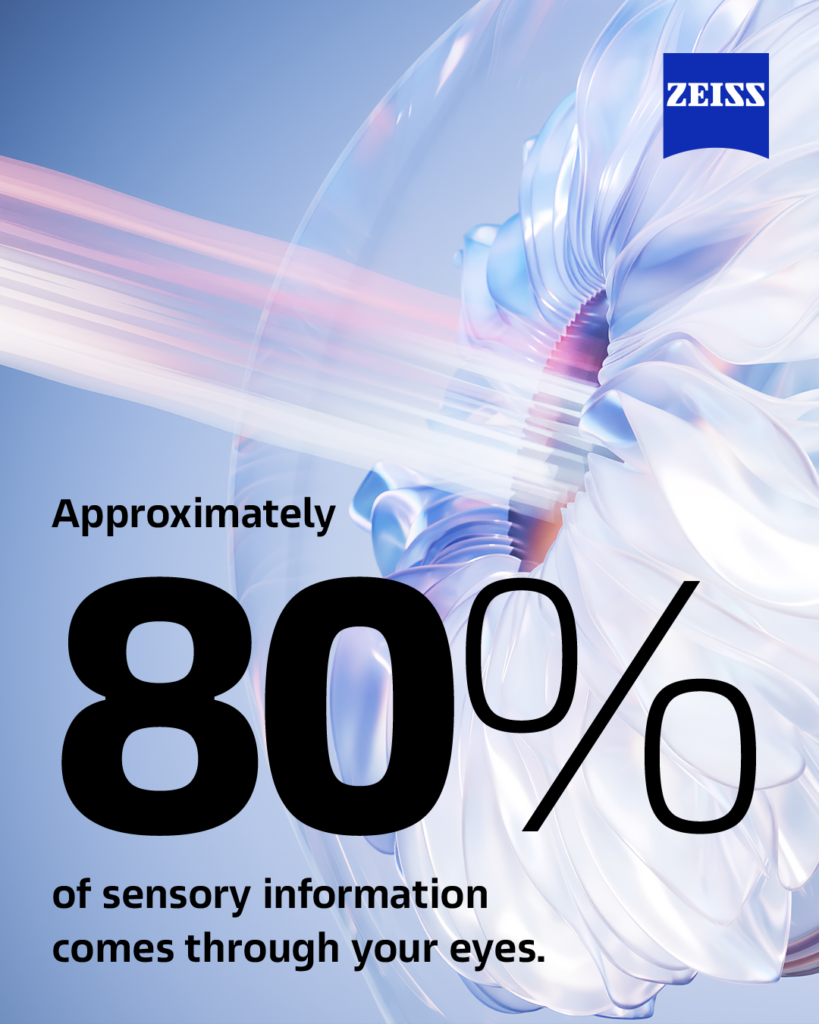

In today’s world — dominated by screens, constant task-switching, and visually saturated environments — the visual system is under sustained, unprecedented demand.
When vision isn’t perfectly crisp, the brain doesn’t simply accept the blur. It compensates. It works harder to fill in what the eye didn’t fully deliver. This additional neural effort is what researchers call cognitive load — and it can have real, measurable effects on how patients feel throughout the day.
ZEISS Vision Care partnered with the University of Tubingen to study this phenomenon directly. Using EEG to measure brain activity during visual tasks, researchers demonstrated for the first time that lens-induced blur increases the perceived cognitive load on the wearer. When visual input isn’t sharp, the brain pays a price — in fatigue, reduced concentration, and diminished overall well-being.
This research validates what many ECPs have observed clinically for years: some patients need more than a correct prescription. They need a lens designed for how the brain experiences vision.
Introducing ZEISS ClearMind Lenses
ZEISS ClearMind lenses are the first lens portfolio from ZEISS built around this neuroscience-driven insight. They deliver extremely clear vision while actively working to reduce the perceived cognitive load of seeing — helping patients feel sharper, more focused, and more comfortable throughout their day.
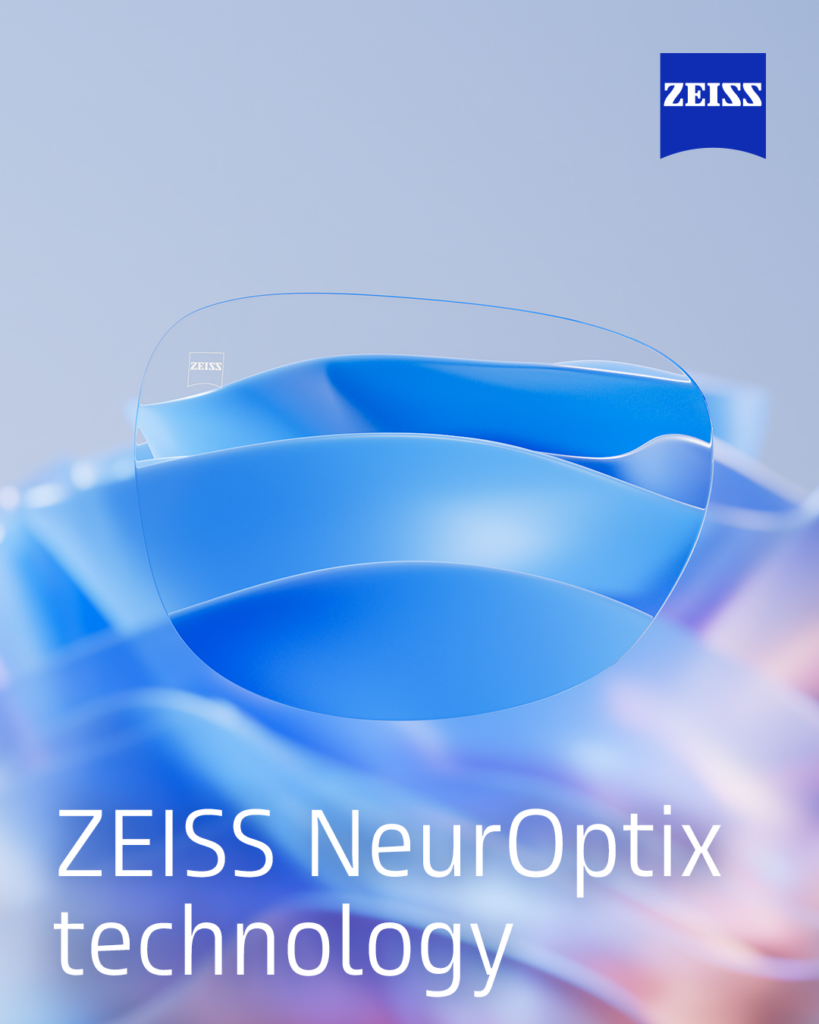
At the core of ClearMind is ZEISS NeurOptix Technology — a proprietary design intelligence that integrates neuroscience principles into lens optimization. It works across five key functions:
► Maps real-world gaze patterns, fixation duration, and zone frequency to understand how wearers actually use their lenses day to day.
► Pinpoints exact lens zones required for each visual task using a mathematical model of the eye, center of rotation, and wear position.
► Links blur levels to cognitive load thresholds — distinguishing unnoticed blur from blur that actively increases perceived mental effort.
► Counteracts prescription-dependent geometric distortions using an advanced optical control algorithm to preserve the intended design fingerprint.
► Creates a lens “neural fingerprint” — delivering clarity where the brain needs it most, with smooth transitions where the eyes naturally move.
The result is a lens designed not just around optics, but around the neurology of vision.
What the Data Shows
In a clinical study using NASA-TLX methodology, ZEISS ClearMind progressive lenses demonstrated 14% less perceived cognitive load compared to a standard ZEISS progressive lens. Wearer results across four global markets reinforced the real-world impact:
► 96% of wearers experienced extremely clear vision.1
► 91% experienced less perceived cognitive load compared to a standard ZEISS lens.2
► 76% reported increased ability to concentrate on tasks.1
► 84% said the lenses contributed positively to their overall feeling of well-being.1
These aren’t just satisfaction metrics. They represent a measurable shift in how patients experience their vision — and a meaningful clinical conversation waiting to happen in your practice.
A Portfolio Designed for Every Patient
ZEISS ClearMind lenses are available across three focal types, each engineered to address the full spectrum of your patients’ visual needs:
Single Vision (18+): Engineered to minimize peripheral blur with up to 48% larger zones of clear vision versus standard ZEISS single vision lenses — expanding the effective visual field and reducing perceived cognitive load through uninterrupted clarity.3
Anti-Fatigue (25+): Designed for patients experiencing early age-related visual fatigue, with accommodative support ranging from +0.25D to 1.25D and up to 28% larger near-vision zones versus ZEISS Digital lenses — with design optimizations that also ease the future transition into progressive wear.3
Progressive (45+): Featuring up to 30% less peripheral blur than standard progressive lenses, an extra-large intermediate zone, and smooth transitions optimized around real-world visual behavior. In wearer testing, 51% adapted within an hour and 88% within a few days.4
Each lens type is available across customization tiers — Pure through Individual 3 — with Individual 3 incorporating ZEISS Intelligence Augmented Design technology, drawing on 12.5 million data points from the ZEISS Global Vision Study to personalize lens performance around each patient’s unique anatomy, age-related visual behavior, and frame selection.
A New Conversation for Your Practice
The patients describing unexplained fatigue, mid-afternoon mental fog, or a vague sense that their vision “isn’t quite right” — they’re not imagining it. And now there’s a clinical framework, backed by neuroscience research, to address what they’re experiencing.
ZEISS ClearMind gives eye care professionals the language and the lens to move beyond acuity and into visual well-being. It positions you to offer something genuinely differentiated: a lens recommendation grounded in how the brain actually processes vision.
When you recommend ZEISS ClearMind, you’re not just correcting what patients see. You’re improving how they feel — every day.
That’s a conversation patients are ready to have. And ZEISS is ready to help you lead it.
Learn More About ZEISS ClearMind Lenses
Talk to your ZEISS Vision Care representative to explore the full ClearMind portfolio, available practice support materials, and training resources.
For patients, schedule a comprehensive eye exam with your local ECP: Find a Practice Locator
For Eye Care Professionals (ECPs): Become a ZEISS Customer
Looking for CE Credits? Multiple Pairs for Modern Vision Needs is now available.
zeiss.com/lenses | Customer Service: 1-866-596-5467
References
1. Opinion-based survey among wearers of ZEISS ClearMind lenses in Germany, Italy, India & China (N=298, Single Vision, Digital & Progressive lenses), 2025, Carl Zeiss Vision International GmbH, DE (unpublished, data on file, Top2boxes)
2. NASA-TLX assessment of perceived cognitive load. Performance test on ZEISS ClearMind progressive lenses compared to standard ZEISS progressive
3. Calculation & Analysis by Technology & Innovation, Carl Zeiss Vision International GmbH, DE 2025. (unpublished, data on file)
4. Opinion-based survey among wearers of ZEISS ClearMind lenses in Germany, Italy, India & China (N=298, Single Vision, Digital & Progressive lenses), 2025, Carl Zeiss Vision International GmbH, DE (unpublished, data on file, Top2boxes)
About Author

I really liked your insights on cognitive load and its effects on visual health! Have you considered how environmental factors like lighting might also play a role 5 letter words? What tips do you have for improving vision well-being in different settings?