Sunshine in December? The concept is virtually unheard of these days in Toronto, Canada, where mid-winter is grey, dark, and dreary. When my flight landed at the sun-drenched Albuquerque airport, I instantly felt my mood lift. The birding trip hadn’t even started yet, and I was already smitten by bluest skies I’ve ever seen and the high desert landscape. I finally understood why New Mexico was known as The Land of Enchantment.
After meeting Carly Crow, our intrepid leader and amazingly knowledgeable birding guide, we headed for Embudito Canyon. After a quick introduction to desert flora, including the beautiful, wildly shaped cholla and prickly pear cacti, we began marveling at the birds in earnest. The Black-throated Sparrows stunned us with their crisp facial markings and black triangular patch on their throat. Curve-billed thrashers and Canyon towhees posed for us and a nimble Greater Roadrunner regaled us by standing still long enough for us to take some photos before scurrying off into the shrubs and cacti. Shortly before leaving, a Cactus Wren made an appearance for us. Seeing this iconic large, polka-dotted desert-loving bird and hearing its loud, screechy song after seeing its nests in the cholla was a treat! Carly’s tremendous natural history knowledge and incredible ear, perfectly attuned to the nuances of every bird’s song, made our first bird walk even more magical.
Something amazing happens when you’re marveling at birds with a group of likeminded, curious nature lovers: you instantly bond, start sharing life stories and travel adventures. By the end of our second hike of the day, when we watched the sun set over the Sandia mountains and basked in their pink glow, it felt like the seven of us had already been talking and birding together for years.
The next morning, we set out in the pre-dawn hours, piled on all our layers and woolens as well as hand and feet warmers, and drove up the mountain Sandia Crest to see one of our target species, the rosy finches. These high elevation specialists thrive in the harshest, most rugged environments imaginable and breed in the tundra, but in the winter months they descend to lower elevation. The Sandia Mountains are one of the most reliable places to observe all three American Rosy-finch species in the winter and we were ecstatic to see the Grey-crowned, Black, and Brown-capped rosy finch all together in one tree! Watching the flock alight right in front of us wasn’t just a dream come true; it felt like an out-of-body experience. I just stared in awe and didn’t even notice my frozen extremities.
As we drove down the mountain and south toward the Bosque del Apache, I felt like the trip couldn’t get any better. How could anything top the experience of being in the presence of three rosy finch species, several Pygmy Nuthatches, and more Townsend’s Solitaires than I could count?
And then we arrived at Bosque del Apache National Wildlife Refuge, about an hour south of Albuquerque. We heard the rattling bugle of the Sandhill Cranes before we saw them, and then suddenly the fields were full of them—prehistoric, elegant, and perfectly streamlined in flight. They surprised us at every turn—we saw them standing, walking, flying, feeding, roosting, congregating, conversing, dancing. Most impressively, we watched their dawn burst, when hundreds of cranes take flight from their nighttime roosts in a choreographed ascent as the sun rises and slowly envelops the mountains in a pastel glow. Thousands of Snow Geese honked and mingled with the cranes, as if competing for our attention. And before we knew it, high overhead, the boisterous geese took to the skies in dynamic ribbons, forming intricate patterns across the horizon.
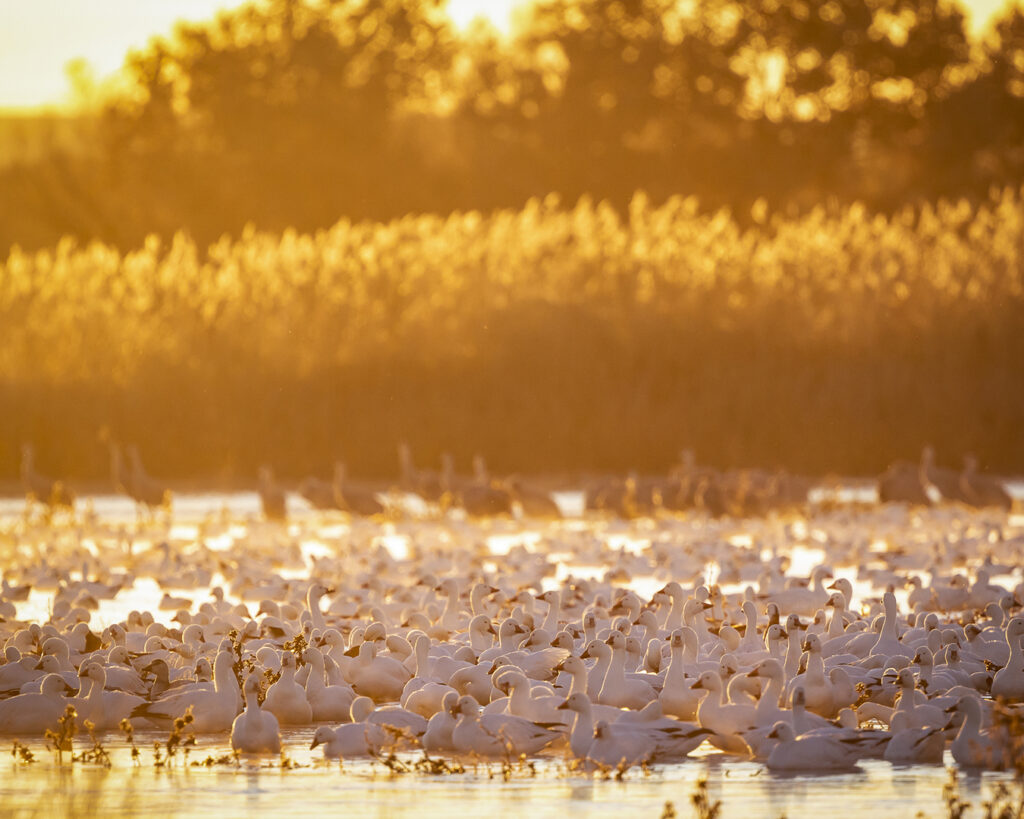
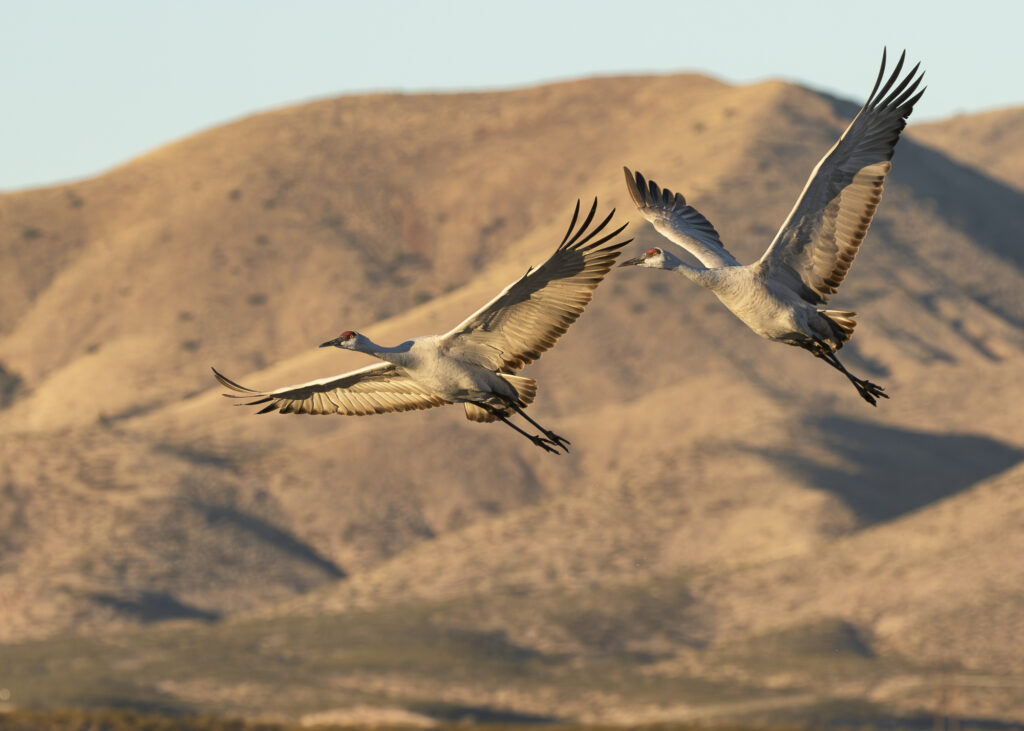
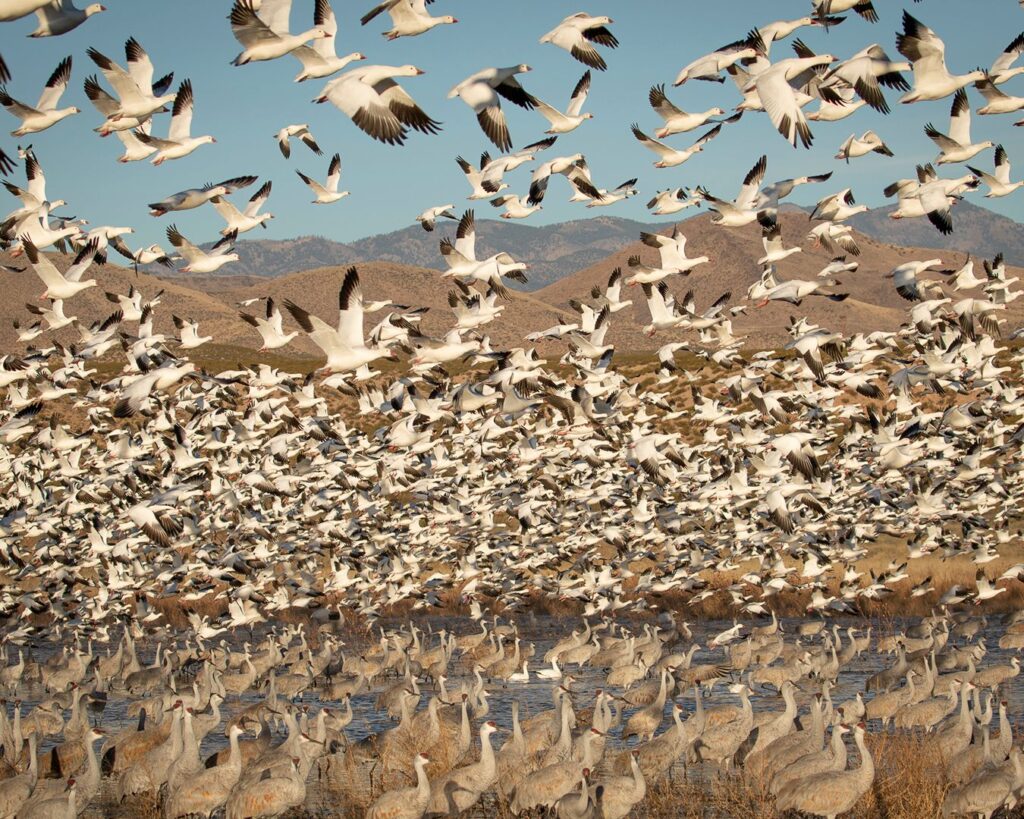
The dawn liftoff left us mesmerized, and over breakfast we wondered whether anything could ever top that. Carly smiled, nodded, and I sensed that she still had a few tricks up her sleeve. Sure enough, we drove out to Lower Water Canyon in the late morning and watched a Prairie Falcon decide whether he was in the mood to hunt Scaled Quail or not (turned out he wasn’t, much to our chagrin). After a short hike in the gorgeous Cibola National Forest, we returned to Bosque just in time to see a covey of Gambel’s Quails scurrying about, as well as a Pyrrhuloxia and a Phainopepla—two of the more spectacularly named birds—and a Crissal’s Thrasher, which turned out to be a lifer for everyone, including our guide! Just as the sun was starting to set over the Bosque del Apache, eagle-eyed Carly detected movement in the shrubs, quickly stopped our van and there, right in front of us stood a glorious bobcat. He disappeared into the bushes, but emerged two seconds later and put on a show for us—his eager paparazzi. Yet nature wasn’t done delivering miracles because as soon as the bobcat absconded, Carly spotted not one, but three Great-horned Owls in trees, silhouetted against the darkening golden sky.
Over dinner at the aptly named Owl Bar & Café in San Antonio, we concluded that the day’s grand finale could not have been more perfect. We finished off our trip with 98 species, but apart from the miraculous bird sightings, the best part of the New Mexico adventure was the warm camaraderie, good humor and new friendships. We’re already planning our reunion.
Her Wild Life Expeditions has partnered with ZEISS to advance women-led conservation through powerful, immersive wildlife viewing experiences.
About Post Author