The goshawk is a forest-dwelling species that, perhaps more than almost any other bird,has mastered the art of flying through dense stands of trees as well as manoeuvring round obstacles at high speed.
The goshawk’s extraordinary manoeuvrability, partly due to its short wings and long tail (Fig. 1), enables it to hunt even in human settlements, where it skilfully utilises the cover provided by buildings. As a result, it has been able to establish itself in some major cities such as Cologne, Hamburg and Berlin, and in some cases even breeds in high numbers. This is partly due to the more favourable food supply in large cities, but, more importantly to the fact that humans there do not hunt the goshawk using net traps of any kind, nor with large timber harvesting machines or chainsaws. Poisoning of goshawks is also less common in large cities than in the rural areas of Germany.
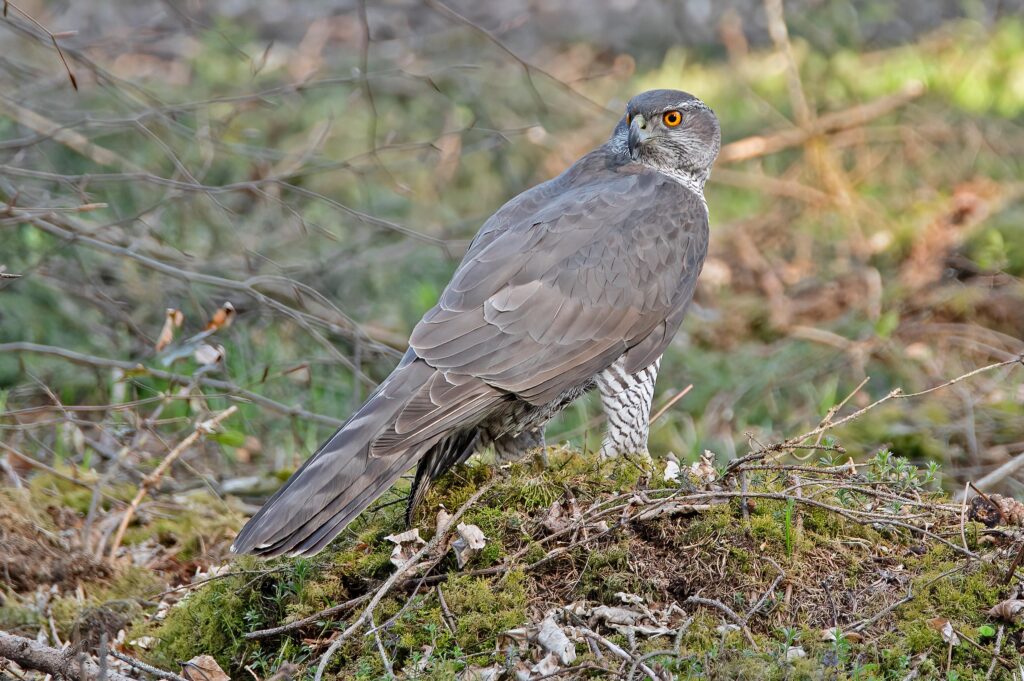
Its relatively short wings and long tail give the goshawk exceptional manoeuvrability, allowing it to fly around obstacles at high speed in both wooded and built-up areas.
Another very favourable factor is that urban goshawks are able to build their nests undisturbed in smaller and often even sparse stands of trees, making the breeding site easy to locate and protect. Furthermore, in urban areas, care is taken to avoid felling trees during the growing season – and thus during the breeding season – whereas in the surrounding commercial forests, little consideration is often given to the breeding season in the pursuit of maximising economic profit. Consequently, the prospects for goshawks outside these few urban habitats are becoming increasingly uncertain.
For here, incidentally, it is not only the goshawk but also other bird species that depend on living in forests of varying sizes, which are increasingly being industrialised and converted into intensive timber plantations. Industrial timber harvesting machines, weighing up to 50 tonnes, cause massive soil compaction and encroach upon the breeding sites of many species – even during the breeding season – ecologically destroying the nesting trees themselves or the immediately adjacent trees that provide cover (Fig. 2). This massive transformation is becoming increasingly evident in the form of so-called ‘skid trails’ (Fig. 3), which are cut into the forests at more or less right angles to the main tracks at intervals of 40 metres, and in some cases as little as 30 or even 20 metres. The greatest impact is being felt in the old spruce and fir stands, which are of particular ecological value, but old beech trees are also increasingly being harvested, much of which is then transported to China – a process that further contributes to climate change.
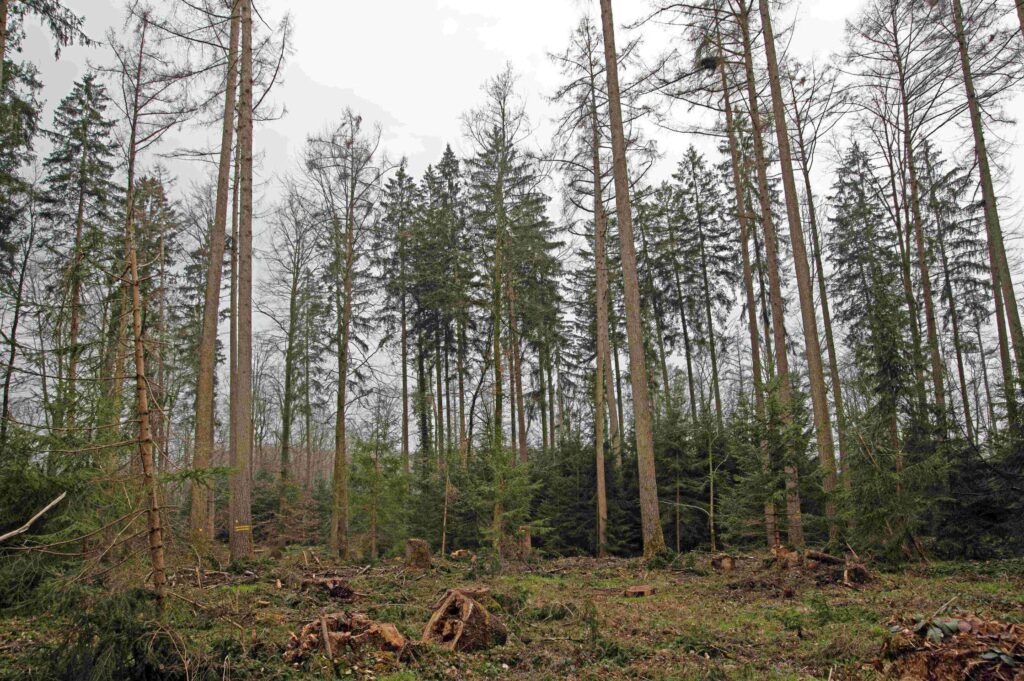
Radical thinning of mature woodland destroys the breeding sites of birds of prey, as these consist not only of the nest tree itself but also of the surrounding trees.
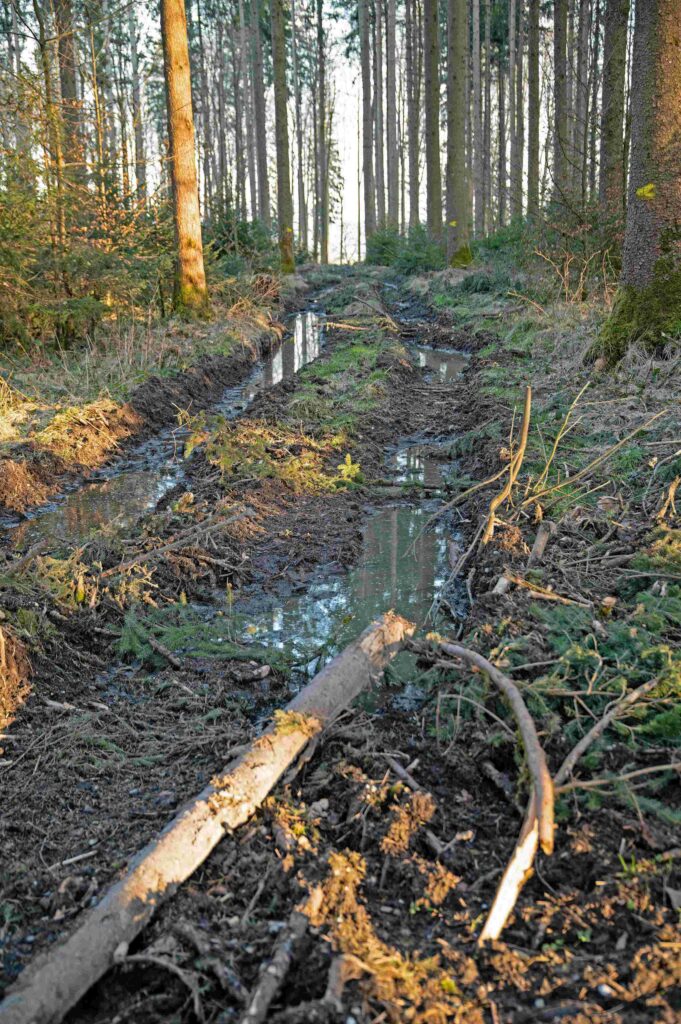
A dense network of skid trails designed for plantation forestry is already being cut through the woods to provide easy access for large timber harvesting machines.
Under these conditions, goshawks retreat deep into the forests and breed there in the oldest, most dense stands of trees, provided these are sufficiently dense and allow for the construction of a large nest as high as possible. Conifers such as fir and larch, but also spruce and pine, are preferred to deciduous species (Fig. 4), but do not represent a limiting factor, as the goshawk is also capable of breeding in deciduous species such as beech and oak. However, a stable base is essential for its large nest, which can have a diameter of up to 1.5 metres. This alone explains its preference for mature, stand-forming trees over 70 years old. As these are now being eliminated on a large scale, this creates a problem not only for the goshawk but also, for example, for the honey buzzard, red kite, black stork, pygmy owl and Tengmalm’s owl, as well as various species of woodpecker.
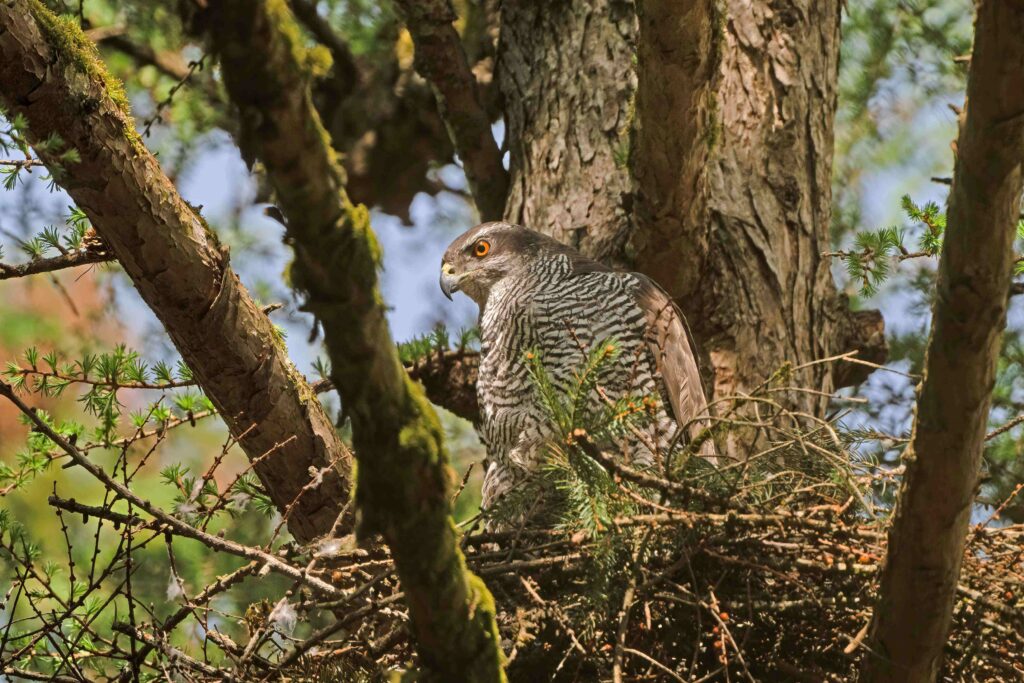
A female goshawk keeps watch over the area around her nest. In the face of large-scale, profit-driven destruction of old-growth woodland, the bird faces an uncertain future.
The new 48-page ‘Zeiss Edition on Field Ornithology’, Issue 4, examines the goshawk’s forest habitat in detail, taking into account coexisting species and anthropogenic influences such as forestry and free-range poultry farming.
Financially strong operators of large sawmills are increasing their profit margins by processing timber with a smaller trunk diameter of less than 50–60 cm, which means that trees in future timber plantations are not expected to grow older than 60 to 70 years. Modern, profit-oriented sawing machines only yield maximum profits for the operator when running at full capacity without interruption; consequently, forestry operations may be forced to sign supply agreements committing to continuous delivery. However, this means that timber is felled not only in winter, as was previously the case, but also during the breeding season, which inevitably results in the death of tens of thousands of animals. Wet timber storage facilities at processing plants could provide a solution to bridge the breeding season. Empty phrases such as ‘We only take what will grow back’ are as nonsensical as they are false. After all, intensive maize cultivation has long been doing exactly that, with the difference being that maize is allowed to reach the same height as the previous year, whereas old trees in the forest are felled and the regrowing trees – some of which are non-native – are to be ‘harvested’ much earlier at a smaller size to maximise profit.
The goshawk’s breeding population has already halved across a 700 km² monitoring area in Upper Swabia. Furthermore, the breeding success of the remaining breeding pairs in areas affected by forestry activities fell by 60 per cent to 40 per cent compared with undisturbed pairs. Overall, the total failure rate doubled from 20 per cent to 40 per cent. Nevertheless, the research findings showed that the goshawk by no means suffers from a lack of food even outside food-rich urban areas, but rather from increased disruption to breeding sites caused by forestry activities and ongoing persecution by amateur pigeon fanciers and free-range chicken farmers.
Finally, the invention of the ‘chicken mobile’ in the wake of growing demand for free-range eggs since the turn of the millennium has led to an increase in free-range chicken farming. Particularly for organic eggs, it is essential – and indeed must be guaranteed – that production takes place in an environmentally and nature-friendly manner, without the killing of birds of prey and thus without any illegal activity. Anyone wishing to enjoy free-range or even organic eggs should therefore ensure that these come from production methods that are compatible with nature and do not destroy it.
About Post Author