An effective coaching approach for Scrum Masters
Let me start with a question: Why do you need another coaching technique? Is it perhaps because many techniques do not have the desired impact with some team members and in certain situations? If so, why is that? Alongside many well-known causes, my new hypothesis is the lack of mandate clarification between team member and Scrum Master. You can find further details on this here.
In this article, I would like to introduce you to the underlying attitudes associated with systemic questioning techniques. In my experience, this coaching technique can partially compensate in practice for the difficulty caused by missing mandate clarification.
The aim of this article is to give you an overview of the attitudes and questioning techniques so that you can decide whether it makes sense for you to engage more deeply with this topic. To do this, I will highlight attitudes and the core of some key types of questions (there are certainly more), and provide practical examples that can be immediately helpful.
Throughout the article, all person-related terms such as “Scrum Master” are used in a gender-neutral way and always include all genders equally.
1. Where do systemic questioning techniques come from?
Systemic questioning techniques have their roots in systems theory1 and family therapy2. The development of systemic questioning techniques reflects a shift in psychotherapy away from a problem-focused approach toward a solution-oriented and resource-oriented one.
The questioning techniques are designed to promote self-reflection and enable clients (in a project setting: team members and other people being questioned) to broaden their perspectives and thereby discover new options for action.
To widen the clients’ scope for action and ensure the effectiveness of specific questioning techniques, therapists (in a project setting: coaches or Scrum Masters) adopt various attitudes. The more authentically these attitudes are lived, the more likely it is that a process of insight will be triggered in clients using systemic questioning techniques.
2. What are the helpful attitudes?
2.1. Constructivism3
This attitude states that people construct their own reality through experiences and interpretations. Everyone sees the world from their own experience and perspective. Multiple truths are therefore normal.
In practice: Explore the other person’s world by not knowing and not understanding4.
- Can you give me some insight into how you came to this view? I’d like to understand it.
(Italic parts can be adapted to your needs.) - I’m curious what’s keeping you from being on time.
- I’d like to understand how this could happen.
- Can you imagine trying that once?
2.2. Circularity
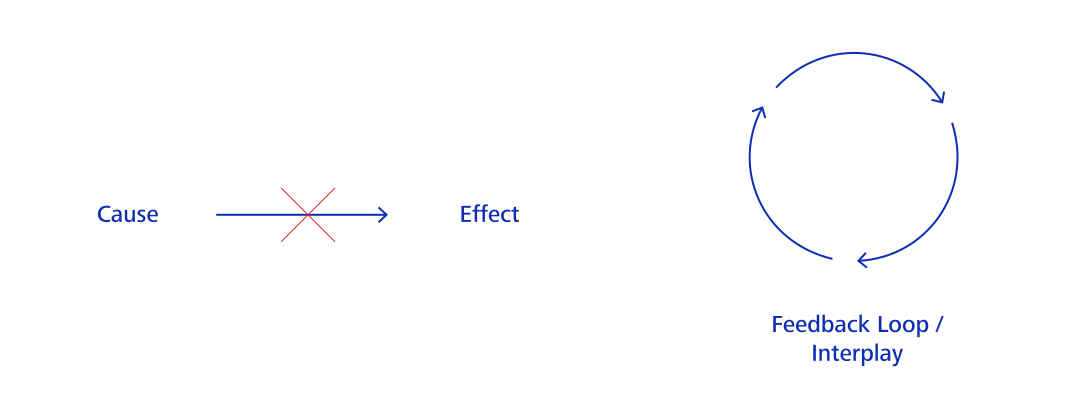
Circularity refers to the idea that everything in a system is interconnected and mutually influencing. Instead of looking at linear causes and effects, the focus is on feedback loops5 and interplay6 between members of a system. This helps to identify patterns and dynamics that influence behavior.
In practice: Recognize patterns
- The more team member A controls, the more/less responds team member B with „working the rule”,
and the more team member A controls. - Whenever everyone is late, the facilitator becomes unmotivated and everyone is even later.
2.3. Observe everyone’s reactions
This attitude encourages you to reflect on your own perceptions and resulting feelings as well as those of others and to use them as a source of information. It is about becoming aware that each person has their own perspective and their own reactions. By directing attention to reactions, you can question your own assumptions and perspectives.
In practice: Use your focus consciously as an information source – “Energy flows where attention goes“7
- How do I feel about what I am seeing and hearing?
- How do other team members feel and react? (I am the observer of my own and others’ reactions.)
- What you say evokes a pleasant feeling in me and I’m impressed.
2.4. Coachee and resource orientation
Here the focus shifts to people’s strengths and resources instead of just their problems. The basic idea is that everyone has abilities and potential to handle challenges. In systemic counselling, this view is used to encourage clients and strengthen their sense of self-efficacy.
In practice: Use your own resources to develop and try out solutions you feel capable of implementing.
- Explicit coaching: only the other person’s interests and needs guide the coaching and its content.
- Implicit coaching: the Scrum Master coaches toward agile improvement even without a perceived need on the part of the team member (due to the missing mandate clarification we risk violating coachee and resource orientation and jeopardizing a good relationship with the team member).
- Every system (similar to a team) has the resources to solve arising problems8
- The focus is on constructing solutions9
- Only each team member individually knows what actions they can imagine or are willing to try
– and that is respected!

Figure 2: Focus on resources
2.5. People are not something; people behave in certain ways10
The idea is that people’s behavior is not fixed, but that they act differently in different contexts. Instead of labelling or judging people, the focus is on the behavior that occurs in specific situations.
In practice: By explicitly highlighting specific behavior, you emphasize the possibility of change.11
| Negative example: trait | Positive example: behavior |
| Team member A is unpunctual. | Lately, team member A has been arriving late to meetings. |
| You are unpunctual. | You haven’t been arriving at meetings on time. What has kept you from being on time recently? |
| Team member B is dependent / not proactive. | Team member B has not yet taken on new tasks independently. |
| You are not agile. | Why do you find it difficult to give your estimates in complexity? |
These are the key attitudes in the systemic understanding. Living them requires practice and effort. If participants in the conversation feel that the dialogue follows an artificial pattern, they may interpret it as inauthentic. Authentic implementation is an art in itself. Which way of implementing these fits you as a person?
Now let’s move on to the core of this article.
3. The systemic questioning techniques
In one sentence: it is always about asking, in an appropriate way, a question that refers to additional perspectives and thus enables the conversation partner to gain new insights.
3.1. Circular questions
This technique aims to illuminate the relationships and interactions within a system. A question such as “How do you think your Product Owner (PO) will react to your decision?” makes perspectives and interactions visible so that patterns can be recognized.
Goal: New information and thought processes through new perspectives12 13
- What would other team members say you could contribute to help keep the timebox?
- What would be a good outcome of this Review for the stakeholders, and what for the developers?
- What do you think it triggers in the team members when you influence the estimates? – addressed to the PO
- What would the PO say is the reason why all stories weren’t finished? – addressed to developers
- What would you do in my place as Scrum Master?
3.2. Exception questions
These questions look for situations in which the problem does not occur or is less intense. They help identify resources and solutions. One example: “Was there a time when the problem was less present? What was different then?”
Goal: Clarify differences and their conditions (and show that things can be different)14
- When did we keep the timebox?
- What did we do differently then?
- Why was the time sufficient then?
- How can we do more of what was different at that time?

3.3. Hypothetical questions
These questions stimulate imagination and encourage thinking about possible scenarios and their impacts. They can help explore new options and solutions. An example: “What would be different if you could successfully handle this challenge tomorrow?”
Goal: Enable playful, non-threatening “test driving” of behavior15 (unrealistic experiments welcome!)
- What if, after your next presentation, you were praised instead of criticized? What could be the reason for this unexpected behavior?
- Assuming this “working to rule” is a form of protest – what might it be directed against?
- If we imagine we drop estimation entirely, what would be the consequences?
- Let’s say we had already determined the business value for all items – would that help you? If yes, why and how?
3.4. “Worsening” questions (paradoxical questions)
“Worsening” questions deliberately exaggerate the problem or situation in order to gain new insights and perspectives. By answering these questions and then potentially doing the opposite, you explore the boundaries of the problem and identify possible resources or solutions. Keep in mind that a large portion of the derived “reverse conclusions” will already be known. The difference comes from the few percent that are refreshingly new.
Goal: Clarify how problems are created and maintained; the reverse conclusion shows how to get rid of the problem16
- Suppose we wanted to multiply the number of our bugs – what would we have to do?
- What would cause the conflict to escalate one hundred percent?
- What can we do to significantly reduce story quality? Who could help us with that?
- To make sure that stakeholders understand nothing in the Review, what should we do? (see Table 2)
| Step 1: Ideas | Step 2: Reverse conclusion (feel free to exaggerate) |
| Exclude stakeholders | Invite stakeholders in an unusual way (e.g. GIF, postcard, with team photo) |
| Go straight into details | Start with an overview and give an outlook |
| Speak unclearly | Speak clearly and practice handovers |
| Play disruptive noises | Use acoustic cues that lighten things up and introduce the next agenda item to re-focus attention |
| Don’t share the screen | Share the screen and present content with a storyboard / script |
| Ignore questions | Reward questions (points system, sweets, honorary titles) |
| Ignore feedback | Reward feedback (points system, sweets, honorary titles) |
3.5. Scaling questions17 18
This is my favourite technique because it is so simple and practical to apply. It creates comparatively high clarity.
These questions help to quantify subjective perceptions (for you it’s a 5, for me it’s an 8) and make progress visible (earlier it was a 3, now it’s a 6). They are useful for measuring change and setting goals.
Goal: Clarify information by ranking and quantifying degrees or intensities
- How satisfied are you with the process, content, and outcome of the Planning on a scale from 0 (extremely dissatisfied) to 10 (perfect)?
- Which of the features is the most complex and why? Which one is less complex? …
- How high would the team members estimate your share of speaking time in the Daily, in %? Do you think that’s fair? What would you prefer? What can you and I do so that you get closer to this goal?

Now you’ve gotten to know some systemic questioning techniques. Can you imagine trying out the attitudes and techniques? In my experience, it’s like many things: with some practice and time, it becomes easier and the quality improves. Practice beats theory.
Conclusion
The successful use of systemic attitudes and questioning techniques depends on many factors. The challenge for the questioner lies in formulating questions in a way that suits the situation and feels authentic, while consciously adopting the described attitudes at the same time. Responding well to the answers is also an art in itself. This aspect would be a good topic for a follow-up article.
Depending on the questioning technique, the demands on the person being questioned can be relatively high. Quantification, capacity for reflection, and empathy are required; creativity and expressive ability are also helpful. Because of these requirements, systemic questioning techniques also have clear limits.
Nevertheless, they may be the strongest technique for partially compensating – through implicit coaching – for the structural weakness in Scrum: missing mandate clarification.
How promising do you find this approach?
I wish you every success and thank you for your attention.
Carsten Zehler
Bibliography
Barthelmess, Manuel: Die systemische Haltung. Was systemisches Arbeiten im Kern ausmacht, Göttingen: Vandenhoeck & Ruprecht GmbH & Co. KG 2016
Bertalanffy, Ludwig von: General System Theory: Foundations, Development, Applications, New York: George Braziller 2015
Erpenbeck, Mechthild: Wirksam werden im Kontakt. Die Systemische Haltung im Coaching, 4. Auflage, Heidelberg: Carl-Auer Verlag GmbH 2021
Palazzoli, M. Selvini / Boscolo, L. / Cecchin, G. / Prata, G.: Paradoxon und Gegenparadoxon. Ein neues Therapiemodell für die Familie mit schizophrener Störung, Stuttgart: Klett-Cotta Verlag 2011
Radatz, Sonja: Beratung ohne Ratschlag. Systemisches Coaching für Führungskräfte und BeraterInnen, 10. unveränderte Auflage, Wolkersdorf, Österreich: Literatur-VSM e.U. 2018
Schlippe, Arist von / Schweitzer, Jochen: Lehrbuch der systemischen Therapie und Beratung I. Das Grundlagenwissen, Göttingen: Vandenhoeck & Ruprecht GmbH & Co. KG 2012
- Bertalanffy 2015 ↩︎
- Palazzoli/Boscolo/Cecchin/Prata 2011 ↩︎
- Schlippe/Schweitzer 2012, pp. 120 ↩︎
- Barthelmess 2016, pp. 24 ↩︎
- Schlippe/Schweitzer 2012, p. 205 ↩︎
- Barthelmess 2016, pp. 218 ↩︎
- Erpenbeck 2021, p. 12 ↩︎
- Schlippe/Schweitzer 2012, pp. 209 ↩︎
- Schlippe/Schweitzer 2012, p. 210 ↩︎
- Radatz 2018, pp. 44 ↩︎
- Radatz 2018, pp. 44 ↩︎
- Schlippe/Schweitzer 2012, pp. 254 ↩︎
- Radatz 2018, pp. 203 ↩︎
- Schlippe/Schweitzer 2012, pp. 266 ↩︎
- Schlippe/Schweitzer 2012, p. 264 ↩︎
- Schlippe/Schweitzer 2012, p. 268 ↩︎
- Schlippe/Schweitzer 2012, pp. 255 ↩︎
- Barthelmess 2016, pp. 135 ↩︎
This post was written by: